Also from 7/23/20, my appearance on the Tom Roton Show on WVHU in Huntington, West Virginia, discussing the COVID suit:
Lifestream Update 7/23 on the Suit Against the WV Governor over his COVID Tyranny
Reply
Also from 7/23/20, my appearance on the Tom Roton Show on WVHU in Huntington, West Virginia, discussing the COVID suit:
Why do we have a hysterical governor trying to shut down our economy again, which he’s not allowed to do in the first place? Look at the current death rate statistics by state of COVID-19: West Virginia is way down at the bottom, along with Wyoming, Montana and Alaska. Of course diagnoses will rise with the exponential increase in testing going on. But show me the death rate. Look at the restrictions in New York, New Jersey, or Michigan, who have required masks and every other restriction you can think of, and their death rates are sky-high. I thought we had a vulnerable population? That’s what the Governor said before he issued his unconstitutional “Stay at Home Order.” So if we’ve gotten so many cases, and we’re so vulnerable, why are we at the bottom of the list (along with the other low population rural states) for death rate per 100,000 people?

Read for yourself: https://www.statista.com/statistics/1109011/coronavirus-covid19-death-rates-us-by-state/
Our Dear Leader appointed a doctor from WVU as our COVID Czar during this so-called State of Emergency. You’ve seen the same types on the cable news. We didn’t elect doctors from WVU, or anywhere else, to authorize them to control our lives, or take our property without due process. Who do you think stands to gain from all this, in research grants, employment opportunities, profit, and so on? What’s in it for them? Can they just cause the governor to go all hysterical and tyrannical with no questions being asked? With no representation on our behalf? Where are all of our legislators? We are now living in a perpetual “State of Emergency.” Just how many months does a State of Emergency last before the legislature does its job?

Our legislators should be asking questions. The medical industry is going to make a fortune off of COVID-19. This is the same bunch, coupled with their benefactors in government, who charge us astronomical prices for common drugs. They require diabetics, who need insulin to live, to keep having to pay to see a doctor avery few months in order keep renewing their prescriptions. Why? Why in the hell should a diabetic need to renew their prescription for insulin just so some doctor can get their cut every few months? You think the lawyers are bad? The medical system is way worse than the legal system, as far as corruption and conflicts of interest go. Remember our very own Sen. Manchin’s daughter increasing the price of the epipen so high that most people could no longer afford it?
The governor is relying on WVU doctors to tell us what rights we get to have? This is the same WVU that prescribed my wife physical therapy for her shoulder, instead of a necessary surgery which could have saved her shoulder function. When we decided to leave the State medical system and go to UVA, they were flabbergasted at the incompetence of the purported best shoulder surgeon at WVU. The shoulder specialist at UVA took an MRI and was astounded. Immediately, being a teaching hospital, he gathered all the students to look at the MRI film. They’d never seen such a bad tear of anyone’s shoulder. Even the specialist had to bring in a sub-specialist to do the surgery. The shoulder was torn in three places. Her bicep was practically hanging by a thread. That was a Thursday, and she was in surgery on Monday. Yet at WVU, the snotty orthopedic surgeon basically told her to toughen up and quit complaining. He spent maybe 5 minutes with her in total, as opposed to the UVA surgeons, who spent probably hours with her.

We didn’t elect them. Maybe they’re right; maybe they’re not. But we didn’t elect them. And even if we did, the executive branch doesn’t enact laws. Our representatives do. Who need to either do their job, or resign. How many more months are we going to allow one governor to rule our state under a State of Emergency? Our State Constitution specifically provides that it will never been suspended – even in a time of war. So why is it suspended?
I know, I know, I’m not allowed to have an opinion because I’m not an epidemiologist, virologist, or other profession which is about to increase in funding levels…. If medical professionals are never wrong, then why are medical mistakes, made by medical professionals, the third leading cause of death in the U.S., causing at least a quarter million deaths per year?
“People don’t just die from heart attacks and bacteria, they die from system-wide failings and poorly coordinated care,” says the study’s lead author, Dr. Martin Makary, a professor of surgery and health policy at Johns Hopkins University School of Medicine. “It’s medical care gone awry.”The magnitude of the death toll – roughly 10 percent of U.S. deaths annually – is striking coming, as it does, in an era dominated by efforts to reform the health system to ensure safe, high quality, high-value medical care. Patient safety efforts have failed to gain much traction, Makary says, because there’s no systematic effort to study medical errors or to put effective safeguards in place.
“Throughout the world, medical error leading to patient death is an under-recognized epidemic,” Makary and his co-author, Dr. Michael Daniel, also of Johns Hopkins, write in Tuesday’s British Medical Journal. They define medical errors as lapses in judgment, skill or coordination of care; mistaken diagnoses; system failures that lead to patient deaths or the failure to rescue dying patients; and preventable complications of care.
https://www.usnews.com/news/articles/2016-05-03/medical-errors-are-third-leading-cause-of-death-in-the-us
See Medical Errors Are Third Leading Cause of Death in the U.S., US News Magazine, May 3, 2016. Are doctors infallible? Do doctors even know what the hell they’re talking about yet, based on actual empirical evidence about the COVID-19? No. For all we know, they could be guessing, or playing politics.
I’m not trying to knock doctors. I don’t do medical malpractice. My own father is an orthopedic surgeon, who has spent his life wearing masks, and also bathing in people’s blood (figuratively speaking, lol). But those were always new masks every time. He wasn’t walking around with one constantly, or driving around with one on. Nor organizing his life around it. Tell him about the new cases daily, and he’ll say: show me the death rate. The more you test, the more cases you’ll have.
If it’s really an epidemic, we’ll all get it at some point. Who among us has never had the flu? The most important part of the entire ordeal is, but yeah, did we die? Some will. But I also heard a story while in court this morning, about a guy who got his penis disintegrated in an electrical accident. Shit happens. We move on with our life. None of this is a reason (nor could there ever be a sufficient reason) to end the great experiment in freedom that is America. People have never been safer from death, nor more prosperous, in the entire history of the Earth.
In an obese, unhealthy state, as West Virginia is, why isn’t the Governor concerned with the almost 5,000 deaths per year in our state alone due to heart disease? I’m sure he could think of all sorts of executive orders which actually could help that problem, assuming it were legal for him to do so. He could be like Michael Bloomberg: No 32 ounce sodas (or “pop” as West Virginians generally call it); No more Mountain Dew (the pop, not the sweet nectar of mountain life) because it rots your teeth worse than the meth. Pepperoni rolls could have a mandatory minimum jail sentence. Would these restrictions save lives? Yes. We could have all Michelle Obama school lunches and Michael Bloomberg dinners, and it would no doubt save lives, in the context of heart disease prevention and treatment.
At some point, we’re going to have to say that enough is enough. I’m told that people are about to start getting fired, as well as getting arrested, based on the choice to not wear a mask. All based on the decision of the Governor. We’ll see what happens . . . .
As the attorney for the pending lawsuit against the West Virginia Governor which challenges his executive actions in response to COVID-19, people have asked for my reaction to today’s new mandatory requirement that the peasants of West Virginia are now required to wear masks in public and private buildings.
Here’s the executive order itself.
So it requires masks to be worn in any building outside one’s home, whether publicly or privately owned, unless you’re under the age of 9, have some medical reason which excepts you, or if you’re eating food, or drinking a beverage, or if you are able to “socially distance.” It even seems to allow a Halloween mask to qualify as appropriate under the order. I’m sure he’ll cancel Halloween, so that might be one diamond in a sea of rough (that we can at least use the masks – not that he’ll rob us of Halloween, even though we never needed his permission any of the past Halloweens). It seems to be a situation where the exception is swallowing most of the rule. How do you even enforce such a mandate without definitions of the terms?
I’d love to sue over this, but I highly doubt anyone gets arrested. As such, our currently pending lawsuit probably sufficiently covers this. Even though it’s not an exciting argument, it’s a very clear and simple violation of our State Constitution. We have a tri-cameral form of Republican government. The legislature enacts laws. The governor signs, or vetoes, the laws they enact, and the judicial branch reviews both of their actions to keep them within the confines of the Constitution.

Here, the Governor has unilaterally enacted a new law. You can’t go in a store or any structure other than your own home, unless you’re wearing a mask – even if the mask is useless and pointless. In the end, what’s going to happen here? What’s the point? The Governor gets to do his mask thing, like some of the other governors, and also create some news, appease the numerous Karens on Facebook, who are absolutely terrified to death over everything. And who is going to bear the brunt of attempting to enforce it? I can almost guarantee the police are not going to do a darned thing here. At least I wouldn’t. It will be small businesses across the State who will be forced to decide what to do with this.

Do I close my store? Do I make someone leave if they’re not wearing a mask? What if they say they have a medical reason not to wear one? Is the liability and hassle even worth it? As a shopper, do I just give up on shopping locally and just go back to ordering online? Hell, you can order entire meals now, delivered in a box. As with the other illegal laws he enacted without the legislature, it’s the small businesses that will suffer. And the cherry on the cupcake is the fact that they’ve had no representation. They can’t complain to their elected representatives, because they’ve been powerless – themselves excluded from the entire process.
But, you ask, why is this such a big deal? Do you complain about wearing a seatbelt in your car? Do you know obey the posted speed limits? Do you not use a child safety restraint in your car? Here’s my answer to that. For instance, W. Va. Code Section 17C-15-46, entitled “Child Passenger Safety Devices Required; Child Safety Seats and Booster Seats, is a part of the huge set of written laws by which we’re all bound here in West Virginia, called the “West Virginia Code.” This is the mountain of rules created by our legislature, and signed by past governors. This is what makes it illegal to not drive a little kid around without a children’s car seat. There are many others, requiring the use of seatbelts, helmets on motorcycles, and so on.
Here is the law itself:

W. Va. Code §17C-15-46 provides that:
Every driver who transports a child under the age of eight years in a passenger automobile, van or pickup truck other than one operated for hire shall, while the motor vehicle is in motion and operated on a street or highway of this state, provide for the protection of the child by properly placing, maintaining and securing the child in a child passenger safety device system meeting applicable federal motor vehicle safety standards: Provided, That if a child is under the age of eight years and at least four feet nine inches tall, a safety belt shall be sufficient to meet the requirements of this section.
Any person who violates any provision of this section is guilty of a misdemeanor and, upon conviction thereof, shall be fined not less than $10 nor more than $20….
So, who decided that child safety seats were necessary, and that children under the age of 8 required one? After all, maybe it should be age 10 and under… or maybe age 7….. The answer is, your elected representatives in the legislature. That’s who. Our legislators are supposed to debate things, right? And then vote on it. Contrast the child safety seat law with today’s new mask law: ages 10 and over have to wear one. Because, safety.
I’m not seeing the difference. The State Constitution provides that the Governor can call the legislature into session if he thinks some new immediate legislation needs to be considered. Our State legislature has not met one time, nor considered one fact or piece of legislation, since the whole COVID crisis began. The Governor has had months and months to do so. But he hasn’t. Why? Because what King in history has ever given up power unnecessarily?
Whatever happened to “The Comeback.” We were “West Virginia Strong” (which he stole from the 2016 flood relief response) and also at some point heading down some confusing and nonsensical phase of “The Comeback,” but now we have to wear masks? The last executive order was opening the State to fairs and festivals…. What the heck? As Zoolander would say, “West Virginia Strong? More like West Virginia weak!” Or, “Montani Semper Liberi? More like Montani Semper Servus.”

Is it a coincidence that, of all the days the Governor does this that Time Magazine reports that Governor Justice’s businesses have received millions of dollars of COVID relief packages?
Billionaire West Virginia Gov. Jim Justice’s family companies received at least $6.3 million from a federal rescue package meant to keep small businesses afloat during the coronavirus pandemic, according to data released by the Treasury Department on Monday.
https://time.com/5863410/west-virginia-governor-companies-coronavirus-loans/
Read it for yourself, here: https://time.com/5863410/west-virginia-governor-companies-coronavirus-loans/

Justice acknowledged last week that his private companies received money from the program but said he did not know specific dollar amounts. A representative for the governor’s family companies did not immediately return an email seeking comment.
https://time.com/5863410/west-virginia-governor-companies-coronavirus-loans/
This rings a bell for me. I represented at least one casino-business creditor, who had long been owed money for services already performed by the governor’s casino. We sent a letter threatening to sue. The money just happened to finally come in right about the time the PPP loan cash arrived. I’m not saying it’s aliens, but . . . .
So he’s both making the laws all by himself, and also cashing in on the laws he’s making. No wonder he’s not interested in calling the legislature in. Our case challenging his prior executive orders, which were incorporated into this one in the prefatory clauses, remains pending before the West Virginia Supreme Court. We could still win that case, as they haven’t ruled yet.
If you want to review our case, as well as the Governor’s response, here’s the link, though it’s just a few posts down:
So a few days ago, I represented a guy down in McDowell County, West Virginia, on a misdemeanor charge of driving on a two-lane road in an ATV/UTV/side-by-side. West Virginia law allows you to do this. But apparently there is confusion, or ignorance, in the local sheriff’s department and/or prosecutor’s office. We were forced to have a trial, which resulted in a not guilty verdict. Here’s the actual criminal complaint charging my client with the non-crime of operating an ATV on a two-lane road in West Virginia:


Clearly this police officer was wrong about the law.
W. Va. Code Section 17F-1-1 allows ATVS to:
So, slightly confusing and a few grey areas, but if you’ve been around the Hatfield & McCoy Trails, you know that it’s necessary to use a two-lane road at times to get where you need to go on an ATV. And in other counties, where there are no Hatfield & McCoy Trails, we still need to go down two-lanes at times to get from one place we’re allowed to ride, to another (whether farms/fields/one-lanes/gas stations, etc.)

Unfortunately however, when we arrived to court on this particular case, the prosecutor looked at me in amazement when I told her that the client hadn’t committed a crime, even assuming all the allegations in the criminal complaint are true. She said dismissively that the client could plead guilty and pay the fines. Of course, I said, “no way, Jose.”
So we had a trial. During the trial, the charging police officer testified that no ATVs are ever allowed to be on a two-lane road, and that his supervisor instructed him, in accordance with this, to “clear” ATVs from the roads, because the Hatfield & McCoy system was closed by the Governor due to COVID-19.
But that has nothing to do with the statute. The Governor can’t change the ATV laws by executive order; nor did he attempt to. Accessing the H&M trails isn’t the only reason ATVs are used in West Virginia. The officer cited 17F-1-1 as his legal authority to “clear the roads.” But in reality, the law still says what it says. Therefore, the magistrate judge correctly found my client not guilty.
There had been no allegations of unsafe or improper operation of the ATV – just that he was on a double yellow line. The officer testified that he didn’t know where the client was coming from – nor where he was going. He had no evidence that my client had been illegally operating on the H&M trail system. The complaint itself corroborates this. It didn’t mention anything other than the fact that he caught him on a two-lane.
However, there were facts pertaining to the officer’s conduct. He got angry and took the citation back, after the mayor of the town where this occurred – Northfork – apparently said that ATVs were welcome and allowed in her ATV-friendly town. Muttering the “F word,” the officer left the city hall, confiscated citation in hand. The testimony at trial was that about an hour later, the officer showed up at my client’s residence – the client wasn’t even home at the time – and threw the citation inside the empty, parked ATV in the driveway. That wasn’t the reason for the not guilty verdict, just a bizarre way to re-issue a ticket. But in any event, it was a non-crime, so the verdict was rightly “not guilty.”
Following the trial, I posted on Facebook that my client had been found not guilty, and that the Governor’s tyrannical executive orders had no effect on the state’s ATV laws, and expressed disbelief that the local sheriff’s department and prosecutor’s office would hassle ATV riders, when that’s really the only thing the local economy has going for it at this point. Did I bash a county by saying this? No, facts are facts. I said nothing about the county, unless you’re referring to the sheriff’s department and the prosecutor’s office prosecuting an innocent man for a non-crime.

Let’s look at the facts though…..
To argue that McDowell County doesn’t have a crisis economy is to stick your head in the sand. Pointing this out is not bashing, nor exploiting, the county. Anyone who makes such an accusation, is either ignorant, or a willing propagandist. Hell, in 1963 – I’ll repeat: 1963 – President John F. Kennedy said:
I don’t think any American can be satisfied to find in McDowell County, West Virginia, 20 or 25 percent of the people of that county out of work, not for 6 weeks or 12 weeks, but for a year, 2, 3, or 4 years.
The situation has only worsened there. McDowell County has been classified as a “food desert” by the USDA. In 2017, there were two full-sized grocery stores serving the county’s 535 square miles. The only Walmart super center in the county closed in 2016 Coyne, Caity (April 7, 2018). “In McDowell County ‘food desert,’ concerns about the future”. Charleston Gazette-Mail. Retrieved January 19, 2020. I don’t know that I’ve ever seen another closed Walmart anywhere in the country.

State officials estimate that there are between 5,000 to 8,000 abandoned homes and buildings in McDowell County alone that need to come down. Legislation was introduced this year to fund the removal of many of these “blight” areas. See https://www.register-herald.com/opinion/editorials/editorial-removing-blight-swope-s-measure-important-to-west-virginia/article_6d4359cf-8b21-5430-9769-2f874e8fee9b.html They’ve been working on this for years. From a newspaper article from 2015:
WELCH — For years, it has been difficult for McDowell County officials to recognize the obvious fact that deserted and dilapidated structures countywide represent a negative image for visitors to the county.
“U.S. Route 52 is the gateway to our county,” Harold McBride, president of the McDowell County Commission said during a press conference Friday morning at the McDowell County Public Library in Welch. “It looks like a Third World country,” he said and added that most of the dilapidated buildings are owned by people who live outside the state and “think they have something.”
https://www.bdtonline.com/news/officials-and-coal-operators-work-to-remove-blighted-structures/article_e4961188-00f9-11e5-86d4-4b27287a4886.html?mode=jqm
From the Charleston Gazette in 2013:
There were 100,000 people in McDowell County in 1950. Today, there are about 22,000 residents,” Altizer said.From 2000 to 2010, McDowell County’s population dropped by nearly 20 percent, from 27,329 people to 22,064 people, according to the U.S. Census Bureau.”It is so sad we are losing so much population. Half of our homes are on homestead exemption, which lowers property taxes for people who are over 65 or disabled,” Altizer said during a recent interview in the McDowell County Courthouse.Today, Altizer said, most income to county residents come from coal and natural gas jobs, or from checks retired people receive — Social Security, black lung, the Veterans Administration and United Mine Workers.”The monthly West Virginia Economic Survey prepared by Workforce West Virginia recently reported there were about 6,000 people working in the county, many of them with government jobs or fast-food jobs. We have an older population today. And there are not new jobs here,” Altizer said.”Coal and gas are keeping us going.
https://www.wvgazettemail.com/business/mcdowell-county-fighting-long-term-decline/article_cb381937-e129-59fd-8d7d-f1fb88dbe6a1.html
Here’s an interesting article, with photos from an actual photographer, rather than the few I snapped with my obsolete iPhone. Take a look for yourself and determine if the few pictures I snapped were somehow misleading about the blight in the county:
https://architecturalafterlife.com/2018/01/12/welcome-to-welch/
From the article:


This decline in work lead to the creation of modern era food stamps. The Chloe and Alderson Muncy family of Paynesville, McDowell County were the first recipients of modern day food stamps in America. Their household included 15 people. The city of Welch, and crowds of reporters watched as Secretary of Agriculture Orville Freeman delivered $95 of federal food stamps to Mr. and Mrs. Muncy on May 29, 1961. This was an important moment in history, as it was the first issuance of federal food stamps under the Kennedy Administration. This federal assistance program continued to expand for years to come, and is commonly used across the United States today.
https://architecturalafterlife.com/2018/01/12/welcome-to-welch/
Fortunately for the county, in 2018, the state opened two new trail connections in McDowell County. From a May, 2018 newspaper article:
WELCH — Two new ATV trail connections opening today in McDowell County will give visitors direct access to the city of Welch and the town of Kimball, the Hatfield-McCoy Regional Recreation Authority’s executive director said Tuesday.
“As of in the morning (today), we’ll have the town of Kimball and the city of Welch will be connected to the Hatfield-McCoy Trail in the Indian Ridge system,” Executive Director Jeffrey Lusk said. “This will allow riders of the trails to go into those communities to get food and fuel and to stay. These are two new towns that weren’t on the system. Up until today, the only two towns that were connected were Northfork and Keystone….
The new Warrior Trail will connect with Gary and Welch. ATV riders will be able to travel from the town of Bramwell to the town of War starting on Labor Day, he added. More lodging opportunities are needed to help McDowell County’s communities benefit from the increase ATV tourism traffic.
“We’re opening the Warrior Trail System up on Labor Day Weekend,” Lusk said. “We’re in desperate need of places to stay in War, Gary and Welch come Labor Day Weekend.
Tourism traffic continues to grow on the Hatfield-McCoy Trail’s overall system, Lusk stated. Last year, overall permit sales were up by 15.1 percent, and both Mercer and McDowell Counties had the highest growth in sales.
https://www.bdtonline.com/news/new-trail-links-opening-on-hatfield-mccoy/article_6d82ce36-5e22-11e8-a13b-a3912708cd04.html
Being an ATV rider myself, I know first hand how the community benefits from the ATV economy. Local entrepreneurs now have opportunities to open ATV resorts, restaurants, and other businesses, which cater to ATV riders. ATV riders bring money. These new ATVs are 15-30k vehicles, each, when it comes to the side-by-sides, and not far off from that for the individual four wheelers. Watch them drive in. They’re driving 70k trucks, pulling 10k trailers, in many instances. They’ve invested heavily in the hobby. They spend money, not only on their equipment, but on food, lodging, gas, and so on. And they come from all over. I’ve even seen guys who drove all the way from Mexico to ride these trails.

Some of them even invest in local real estate, such as the client I represented in this case, who loved the community so much, he bought his own place. But go on and attack me for daring to “bash” McDowell County…. So let’s continue with some facts, instead of knee-jerk emotion.
What are some of the side effects of the economic problems?
Of 3,142 counties in the U.S. in 2013, McDowell County, West Virginia ranked 3,142 in the life expectancy of both male and female residents. See http://www.healthdata.org/sites/default/files/files/county_profiles/US/2015/County_Report_McDowell_County_West_Virginia.pdf,; see also https://en.wikipedia.org/wiki/McDowell_County,_West_Virginia
Males in McDowell County lived an average of 63.5 years and females lived an average of 71.5 years compared to the national average for life expectancy of 76.5 for males and 81.2 for females. Moreover, the average life expectancy in McDowell County declined by 3.2 years for males and 4.1 years for females between 1985 and 2013 compared to a national average for the same period of an increased life span of 5.5 years for men and 3.1 years for women…..
Then there’s the drug problem. In 2015, McDowell County had the highest rate of drug-induced deaths of any county in the U.S., with 141 deaths per 100,000 people. The rate for the U.S. as a whole is only 14.7 deaths per 100,000 people. (Same citation).
So back to my original point. There’s 99 problems there, and ATVs ain’t one of them. So why hassle ATV riders when they’re bringing money, jobs and fun into the local economy?
Again, ATVs are allowed on single lane roads in West Virginia, and are also allowed on two-lane roads, to get from one place they’re allowed to operate, to another place they’re allowed to operate, so long as it’s a distance of 10 miles or less, and so long as they operate on the shoulder, or as far as the right as possible, and under the speed of 25 mph. Counties and cities in West Virginia are granted the authority by the legislature to increase ATV freedoms. Other than interstate highways, they can authorize ATVs to use two lanes within their jurisdictions with no restrictions whatsoever. That would be what signage would refer to as being “ATV Friendly.”
That’s the law anyways. Whether or not law enforcement and prosecutors in any particular county care or not…. well that’s a different issue.
Senate Bill 690 is now in effect in West Virginia. ATVs, side by sides, UTVs, can now be made “street legal” in West Virginia. They are calling this group of vehicles with confusing names, “Special Purpose Vehicles.”
SPVs can now be turned into “street legal SPVs.” The following requirements must be met:
(1) One or more headlamps;
(2) One or more tail lamps;
(3) One or more brake lamps;
(4) A tail lamp or other lamp constructed and placed to illuminate the registration plate with a white light;
(5) One or more red reflectors on the rear;
(6) Amber electric turn system, one on each side of the front;
(7) Amber or red electric turn signals;
(8) A braking system, other than a parking brake;
(9) A horn or other warning device;
(10) A muffler and, if required by an applicable federal statute or rule, an emission control system;
(11) Rearview mirrors on the right and left side of the driver;
(12) A windshield, unless the operator wears eye protection while operating the vehicle;
(13) A speedometer, illuminated for nighttime operation;
(14) For vehicles designed by the manufacturer for carrying one or more passengers, a seat designed for passengers; and
(15) Tires that have at least 2/32 inches or greater tire tread.
Senate Bill 690
Golf carts are being excluded:
(uu) “Low-speed vehicle” means a four-wheeled motor vehicle whose attainable speed in one mile on a paved level surface is more than twenty miles per hour but not more than twenty-five miles per hour.
WV Code §17A-1-1(uu)
A “Special Purpose Vehicle” is defined as:
“Special purpose vehicle” includes all-terrain vehicles, utility terrain vehicles, mini-trucks, pneumatic-tired military vehicles, and full-size special purpose-built vehicles, including those self-constructed or built by the original equipment manufacturer and those that have been modified.
There is a 20 mile limit on the travel on a two-lane road. Controlled-access highways are excluded. That would be interstates and four lanes where there are dedicated access points (on ramps, off ramps, and the like).
The West Virginia Governor finally submitted his response to our Petition for Writ of Mandamus currently pending before the West Virginia Supreme Court, which challenges his COVID-19 executive orders, closing the state’s economy, among other things. Here’s our petition, if you haven’t read it:
Here is the response brief submitted on behalf of Gov. Justice:
At this point, the Court can now rule on the petition by issuing a written opinion, or can schedule oral arguments. Here’s my initial thoughts on the response. It was written by the Solicitor General under the West Virginia Attorney General, rather than by anyone actually in the Governor’s office, or hired by him. Thus, I think the takeaway from what I see here is a lackluster argument about procedure, rather than a position on the constitutional issues presented. It seems to me that what’s more important, is what went un-said, rather than what was said.
The Governor’s response doesn’t really contest the allegations that he’s acted beyond his constitutional limitations, but rather argues that it should be up to the legislature to stop him, rather than the judicial branch. If that’s the case, then what’s the point of having a judicial branch? It is exactly the purpose of the West Virginia Supreme Court to review questions regarding the extent of the Governor’s executive powers. While they argue that it should be submitted to a circuit court judge first, it would still go right back to the Supreme Court to be decided. It would just cause delay.
Again, reading between the lines here, my takeaway from their filing is, they sent an implicit message to the Court that, so long as they sufficiently address and decide the procedural questions, the Attorney General’s position is that there’s no substantive defense to the constitutional issues. Therefore, if the Court desires the case to go before a circuit court judge first, for some reason, then we can do that, and at some point the constitutional powers issues must still be addressed. I’d be more worried if I saw a convincing substantive argument about emergency powers and its interaction with the state constitution. But I didn’t see one.
As far as the procedural questions go, the response brief focuses on the legislature’s ability to use a supermajority to call itself into session. However, this is a red-herring. Whether or not the legislature is willing, or able, to do its job, or to reign in an out-of-control governor, is besides the point. Maybe they could do it if they had a supermajority. But that doesn’t have any bearing on the issue of the extent of the Governor’s executive powers. He either has the constitutional ability to do what he’s been doing; or he doesn’t. That’s like saying that President Trump can be dictator until Congress steps in to stop him. No. He can’t be a dictator, regardless of whatever Congress does, or doesn’t do. These two things are being conflated.
But all in all, I see the response as implicitly supportive on the underlying constitutional arguments. That being said, we’ll just have to wait and see what the Court does. The issues aren’t going away. If they want us to go to circuit court, we’ll go to circuit court. If they want us to serve pre-suit notice, even though it’s not required, we’ll do that and return. If we have to go to federal court to find relief….. we’ll go there. We will obtain judicial review.
From the day we filed:
Being filed today: I’m representing S. Marshall Wilson, of the West Virginia House of Delegates, three other delegates, and one West Virginia Senator, in their challenge to the West Virginia Governor’s COVID-19 executive orders. Here’s the petition being filed. Press conference at the State Capitol, today at 11:00 a.m.
Update: some footage from the press conference at the State Capitol:
Article in Saturday’s Charleston Gazette-Mail:

A word of caution from a suspicious lawyer . . . .So instead of downsizing our massive behemoth of government bureaucracy, Congress passed the CARES Act, establishing the so-called Paycheck Protection Program (PPP), which allows the SBA to guarantee 350 BILLION in loans to help small businesses. As of April 16, 2020, a total of 1,661,397 loans have been made through 4,975 lenders nationwide, eating up all the available money thus far.

Many businesses and investors believe they’re not going to have to pay back these loans. If you believe that, you don’t know government. But there’s way more at stake here than just being required to pay back a low interest loan. Way more. Expect the DOJ to turn their attention to small businesses in the very near future. They’re gonna “help” small business all right….
Take a look at the bill. It’s “Yuge.”
It’s gonna take more government officials to run this thing than would be necessary to run 10 or 12 third world countries. I’m skeptical about who’s paychecks are being protected here. But it’s not just the size of the program that gives me concern. More importantly, these loans have been rushed through, under the hysterics created by the government itself, as well as the media. What does one facing the apocalypse – basically, the scenario of riding motorcycles with spiked shoulder pads – represent on an emergency rushed bank loan application? Therein lies the question of the very near future.
Due to widespread shutdowns, we’re headed into an epic economic depression. That will be a depression for those of us in the private sector. At least at first. They can always take out more debt and print money. But that will collapse too without the forecast of an income stream of real money. The government will want its money from these PPP loans. The government always wants its money. Several quotes come to mind:
The False Claims Act (FCA) is a federal law which imposes liability on persons and companies (see “small businesses“) who defraud governmental programs. This law includes a qui tam provision that allows people who are non-government employees (see lawyers and law firms) called “relators” to file lawsuits on behalf of the government. There’s another name for this: “whistleblowers.” Under the FCA, the relators / whistleblowers receive a portion of any recovered damages – generally 15 to 30 percent. This is the basis or all these pharmaceutical lawyer commercials you see on TV. Those lawyers are gonna jump all over this. We need only look to the last “bailout” from Obama’s TARP program in 2008. Just in 2015 alone, the DOJ recovered over 3.5 BILLION in damages under the FCA. And that was the “fourth consecutive year” for such large damages recoveries, as the DOJ proudly announced. It’s an annual expected component of the budget at this point.
Legal experts who practice in the area of the FCA are already warning other lawyers to expect a heightened focus on individuals and small businesses now that these new loans have been made on such a rushed basis. The DOJ recently restated its “commitment to use the False Claims Act and other civil remedies to deter and redress fraud by individuals as well as corporations.”
And it’s not just the private lawyers. Do you think the mountain of lawyers and investigators at the DOJ are going to sit idly by and do nothing? No, they’re ready to get back to work. Remotely of course. In fact, they’ll need even more resources and employees in order to combat the coming fraud crisis you’ll hear about. “With a new national crises at hand, and an even bigger commitment of federal assistance to combat it, expect a plethora of federal and state agencies to join the effort to police recovery spending. Indeed, oversight mechanisms in the act go beyond establishing the special inspector general and include establishing a Pandemic Response Accountability Committee, which is also charged with oversight.” Id.
Now that’s an acronym that ought to scare the hell out of anyone involved in the application of these loans. I can see that on the side of a van pulling up next to front doors in a Polish ghetto, looking for whatever is deemed verboten.It’s not just the applicants, but the bankers as well, and anyone else connected to the process, or the business. The FCA lawyers and the DOJ, using a theory of mere “false certification” of application information, can go after individuals, small businesses, and the lenders who participated in the program. All it takes is to show false information included in the laundry list of certifications in the applications, including, but not limited to:
What is “necessary” and who gets to determine what was “necessary?” And who gets to determine what the recipient “intended?” If the FBI can make General Flynn into a convicted felon just by asking their questions in a certain tricky way, what can they do to you? Not only that, but these applicants are also certifying to all other information provided in these applications. Just take a look:

Government doesn’t word things in such a way as to be concise and clear so that everybody’s on the same page. They word things in such a way so that, if they want to get you, they’ll get you:

Who’s angus is on the line? It’s not just the person who signs the application, but many other potential individuals within a “small business”:
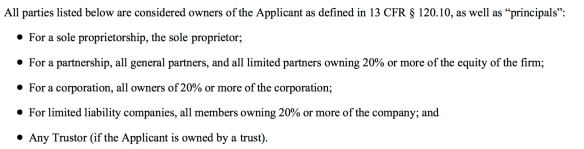
Lastly, to go after you civilly, rather than criminally, under the FCA, the DOJ doesn’t have the usual constraints of the Bill of Rights and the standard of beyond a reasonable doubt. Instead, they only need to prove the civil standards of “deliberate indifference” and “reckless disregard.” You know, like what happens many times when you rush through an emergency apocalypse relief application. It’s just paperwork….
“If Congress can do whatever in their discretion can be done by money, and will promote the General Welfare, the Government is no longer a limited one, possessing enumerated powers, but an indefinite one, subject to particular exceptions.” – James Madison
So, we end up doing a lot of domestic violence protective order litigation in both Greenbrier and Monroe County, WV. This past week has to have been one of the craziest weeks on record, with some of the most insane, bizarre, and malicious, human behavior I’ve encountered in the past decade or so…..
As I sat trying to negotiate a resolution with one particular pro se (unrepresented by a lawyer) party a couple of days ago, it became apparent to me that people don’t know what the “F” they are doing….
The West Virginia Legislature has adopted a civil remedy where victims of domestic violence can obtain what is essentially a restraining order. So what is “domestic violence” according to this law?
The Prevention and Treatment of Domestic Violence Act, West Virginia Code §§ 48-27-101 et seq., defines “domestic violence” or “abuse” as specific acts between family or household members that involve:
1. Attempting to cause or intentionally, knowingly or recklessly causing physical harm to another with or without dangerous or deadly weapons;
2. Placing another in reasonable apprehension of physical harm;
3. Creating fear of physical harm by harassment, stalking, psychological abuse or threatening acts;
4. Committing either sexual assault or sexual abuse as those terms are defined in articles eight-b [§§ 61- 8B-1 et seq.] and eight-d [§§ 61-8D-1 et seq.], chapter sixty-one of this code, and;
5. Holding, confining, detaining or abducting another person against their will. W. Va. Code § 48-27-202.
The statutory definition of domestic violence is narrower than the commonly accepted definition of domestic violence because it primarily defines domestic violence as acts of physical violence, and only includes psychological abuse when it creates fear of physical harm. Although psychological abuse may not meet the statutory definition of domestic violence by itself, this type of abuse may be relevant to a proceeding involving domestic violence because it provides evidence of an abuser’s motive, intent, or plan. Additionally, evidence of psychological abuse may provide insight into the actions of both the abuser and the victim.
In addition to the definitions set forth in West Virginia Code § 48-27- 202, the West Virginia Legislature has criminalized acts of domestic assault and domestic battery by the enactment of West Virginia Code § 61-2-28. The distinction between domestic assault or battery and non-domestic assault or battery is that the domestic abuse must occur between family or household members. The Legislature has also established enhanced penalties for subsequent domestic assault and battery convictions. The enhanced penalties demonstrate that the Legislature both recognizes the repetitive nature of domestic violence and punishes it accordingly.
Providing further protection for domestic violence victims, West Virginia Code § 61-2-9a criminalizes stalking, harassment, and threats. As with domestic assault and battery, this code section establishes enhanced penalties for subsequent convictions. It also authorizes a court to issue a restraining order for a period of up to ten years upon conviction. When a defendant is charged with either harassment or stalking, it is a condition of a bond that the defendant shall have no contact with the victim. Although this code section could be applied to situations that do not involve domestic violence, this code section provides meaningful protection for domestic violence victims because it criminalizes behavior typically identified as domestic violence.
Family Court Judges are taught the following, in addition to the actual wording of the statute:
Although the motive for domestic violence commonly involves domination and control, domestic violence perpetrators employ various methods to achieve that purpose.4 Common psychological tactics include emotional abuse, such as control over finances, repeated and degrading insults, and threats. An abuser is often extremely jealous or possessive, and may isolate a victim from friends, family and other relationships. As another psychological tactic, an abuser may threaten to gain full custody of children. An abuser may also throw things, punch walls or hurt pets.
In addition to emotional abuse, an abuser may push, shove, shake or grab a victim. Other forms of physical abuse include: slapping, kicking, biting or twisting arms, legs or fingers. An abuser may choke, strangle or smother a victim. An abuser may also threaten a victim with a weapon, such as a knife or a gun, and may commit assault with a weapon. Rape or other forced sexual contact is yet one more type of abuse. Physical acts of domestic violence may constitute criminal behaviors, and should not be minimized or tolerated because they are directed against family members.
See 2012 Domestic Violence Judicial Handbook.
2. Some background on “domestic violence protective orders”
Although the motive for domestic violence commonly involves domination and control, domestic violence perpetrators employ various methods to achieve that purpose.4 Common psychological tactics include emotional abuse, such as control over finances, repeated and degrading insults, and threats. An abuser is often extremely jealous or possessive, and may isolate a victim from friends, family and other relationships. As another psychological tactic, an abuser may threaten to gain full custody of children. An abuser may also throw things, punch walls or hurt pets.
In addition to emotional abuse, an abuser may push, shove, shake or grab a victim. Other forms of physical abuse include: slapping, kicking, biting or twisting arms, legs or fingers. An abuser may choke, strangle or smother a victim. An abuser may also threaten a victim with a weapon, such as a knife or a gun, and may commit assault with a weapon. Rape or other forced sexual contact is yet one more type of abuse. Physical acts of domestic violence may constitute criminal behaviors, and should not be minimized or tolerated because they are directed against family members.
A protective order proceeding has the added advantage of a lower burden of proof. Often, there are no witnesses to domestic violence other than the abuser and the victim, and the evidence may not meet the criminal standard of proof of beyond a reasonable doubt.
Although protective order proceedings provide a legal remedy for domestic violence victims, some professionals involved in the proceedings may question their efficacy.48 In a study examining victims’ strategies to combat domestic violence, the results indicated that 30% of the victims who obtained an initial ex parte protective order did not appear at the final hearing.49 Examining the reasons for this occurrence, it was noted that law enforcement failed to serve a petition in 50% of the cases, which in turn either delayed or prevented the entry of a final protective order. Also, petitioners did not attend a final hearing because of conflicts with employment or lack of childcare. A lack of legal representation was an additional reason that victims did not complete the process. Certainly, these institutional barriers must be addressed to increase the effectiveness of protective orders.
The study also indicated that the ex parte orders, in some cases, were sufficient to meet the victims’ needs. Specifically, victims noted that the ex parte order stopped the violence, allowed the victim to separate, or induced the abuser to seek counseling. Based upon these interviews, it was concluded that the failure to obtain a final protective order does not indicate “that the advocate has failed or the woman has been passive in the face of abuse.”50 Rather, protective orders, including ex parte orders, provide an effective legal remedy that can be tailored to meet the needs of domestic violence victims.
3. There must be a “family or household member” relationship
The domestic violence protections and remedies under Chapter 48, Article 27 are tied to occurrences of violence or abuse between “family or household members” as that term is defined under this Act. The only time a proceeding under this Act may involve parties other than “family or household members” is when the petitioner is seeking protection as one who reported or witnessed domesticviolence. See W. Va. Code §§ 48-27-305(3); 48-27-504.
As provided in West Virginia Code § 48-27-204, “family or household members” means persons who:
(1) Are or were married to each other;(2) Are or were living together as spouses;
(3) Are or were sexual or intimate partners;
(4) Are or were dating: Provided, That a casual acquaintance or ordinary fraternization between persons in a business or social context does not establish a dating relationship;
(5) Are or were residing together in the same household;
(6) Have a child in common regardless of whether they have ever married or lived together;
(7) Have the following relationships to another person: (A) Parent; (B) Stepparent; (C) Brother or sister; (D) Half-brother or half-sister; (E) Stepbrother or stepsister; (F) Father-in-law or mother-in-law; (G) Stepfather-in-law or stepmother-in-law; (H) Child or stepchild; (I) Daughter-in-law or son-in-law; (J) Stepdaughter-in-law or stepson-in-law; (K) Grandparent; (L) Stepgrandparent; (M) Aunt, aunt-in-law or stepaunt; (N) Uncle, uncle-in-law or stepuncle; (O) Niece or nephew; (P) First or second cousin; or
(8) Have the relationships set forth in paragraphs (A) through (P), subdivision (7) of this section to a family or household member, as defined in subdivisions (1) through (6), of this section.
The length of this provision is the first indication that the class of persons covered by the term “family or household members” is fairly broad. The statutory definition can be generally broken down into three categories of covered persons. Determinations as to who falls within either of the first two categories is straightforward in most cases. More careful analysis is generally needed if the determination involves the third category of covered persons.
The first category, the “partner” relationships described in subsections (1) through (6) of the statute, encompass parties who are or were — married; living together (whether in a spousal relationship or simply residing in the same household); sexual partners; dating; or parents of a child. Second, the “kinship” categories listed in subsections (7)(A) through (P), cover many of the family connections by blood or marriage. The third category, the subsection (8) “tie-in” provision, brings two parties within the “family or household member” class as long as one party has a “kinship” relationship [under subsection (7)(A)-(P)] with someone who has or had a “partner” relationship [under subsections (1)-(6)] with the other party.
See 2012 Domestic Violence Judicial Handbook.
4. The Logistics
Circuit courts, family courts and magistrate courts have concurrent jurisdiction over domestic violence proceedings. W. Va. Code § 48- 27-301; Rule 25, RDVCP. Emergency proceedings upon the filing of a petition for a protective order are held before a magistrate. W. Va. Code § 48-27-203.
Final hearings, following the entry of an emergency protective order by a magistrate, are typically heard before a family court judge. W. Va. Code § 48-27-205. However, circuit court judges may assist family court judges in the disposition of domestic violence caseloads by conducting protective order proceedings. Rule 25, RDVCP.
Appellate jurisdiction from a magistrate’s denial of an emergency protective order lies in the family court; and appeals from family court
5. The Timeline
A petitioner denied a DVPO may appeal to the family court. The petition for appeal must be filed no later than five days following the denial, and must be heard by the family court within ten days from the date the appeal was filed. W. Va. Code § 48-27-510(a); Rule 18(a), RDVCP.
If the Temporary DVPO is granted, a final hearing before the family court must be scheduled to take place no later than ten days following the entry of the Temporary DVPO. W. Va. Code § 48-27-402(e).
Any party may file a petition for appeal following the grant or denial of a DVPO at the final hearing in Family Court. The petition must be filed within ten days following the decision of the family court. Rule 19(a), RDVCP. The circuit court is required to hear the appeal within ten days following the filing of the petition. W. Va. Code § 48-27-510(b) and (c); Rule 19(a), RDVCP.
6. Never walk into court without a lawyer. Period. Especially not when the words “domestic violence” are in the subject line of the case…..
We are pleased to have been hired to represent a man named James McClurkin. James was convicted of murder in 1977. In late 2016, law enforcement appeared at his parole hearing and testified that the old murder case was reopened, and that James was innocent. James was released. He was 63 years old, and had been in South Carolina prisons since the age of 18.

South Carolina is one of the states which does not provide compensation to innocent people who are wrongfully imprisoned and then later exonerated. Hopefully that legislation can soon be enacted in South Carolina. But until that happens, we are working hard to compensate Mr. McClurkin for the terrible injustice which occurred in his case.
Here are some of the media accounts of his release from prison:
Chester man paroled after 39 years for crime he denies. Were wrong men convicted?
Judge says Chester men must go to S.C. Supreme Court to seek exoneration for murder
‘I am free’: Chester man in prison 43 years goes home, still hoping to be exonerated
The sheriff said he didn’t do it and he was released from prison but stigma impossible to shake.
James McClurkin and his co-defendant were convicted of the 1973 murder of laundromat attendant Claude Killian. James, and his co-defendant Ray Charles Degraffenreid, both African Americans, were convicted under the brutal 1970’s Chester County, South Carolina justice system, which involved, among other things, a presiding trial judge who was known for using the “N word” while on the bench.
The real murderer actually confessed in 1992, which was corroborated by the fact that he was convicted of a similar murder, and by the fact that he had no alibi on the night of the murder. However, the justice system once again failed James, and he was sent back to prison for another 25 years. Now law enforcement reopened the case, and have concluded that the real murderer was telling the truth. How did this occur? Well, among other issues, the mother of the real murderer was apparently the maid of the prosecutor who prosecuted James and Ray Degraffenreid.
This sounds like a novel, but it’s not. It’s real, and it was only uncovered because a courageous new sheriff was willing to give someone the benefit of the doubt, and double check an old case. Follow along as we jump into this case and work to reverse the wheels of justice.
IF YOU LIVE IN SOUTH CAROLINA, PLEASE CONTACT YOUR POLITICIANS AND EXPRESS YOUR SUPPORT IN PLACING THESE CASES BEFORE THE GOVERNOR OF SOUTH CAROLINA. BOTH JAMES MCCLURKIN AND RAY CHARLES DEGRAFFENREID SHOULD BE PARDONED BY THE GOVERNOR OF SOUTH CAROLINA.
You can donate in order to assist with James McClurkin’s living expenses through the following site:
Here is a recent filing in the United States District Court for the Southern District of West Virginia. It has to be one of the oddest things I have ever done in the realm of criminal defense. Most lawyers know that a civil case in state court can be removed by the defendant(s) in certain circumstances. In fact, most plaintiffs lawyers in West Virginia, usually myself included, do everything they can to avoid such a scenario. But did you know that in certain instances, state criminal prosecutions can be removed to federal court? Well it’s true. Similar to being a plaintiff in the 4th Circuit, usually it would be a really bad idea to handle a criminal case in federal court rather than in state court. Defendants almost always get hammered in federal criminal prosecutions. But conceivably there are situations where you do want to be in federal court – especially one in which state court officials (e.g., prosecutors/magistrate judges) have formed a lynch mob and are going after your client.
28 U.S.C. 1442(a)(1) is known as the federal officer removal statute, and allows state court cases of almost any sort to be removed (forcibly) to federal court. It is usually used in civil cases. For instance, if you were to try to sue an FBI agent in state court, it would quickly make its way to federal court using this removal statute, and it would be there about 5 seconds before being dismissed. But 1442(a)(1) also allows for state criminal prosecutions to be removed. It has rarely been used, mostly because scenarios which would invoke it rarely occur. It requires that a federal officer be charged with a crime in state court, and that he or she have a colorable federal defense (usually federal immunity) to the charge.
In our scenario, my client does indeed have a colorable federal defense – LEOSA (Law Enforcement Officers Safety Act). Passed in 2004, it allows current or required qualified law enforcement officers to carry concealed weapons notwithstanding any state or local laws to the contrary. My client is a federal law enforcement officer and was charged with carrying a concealed weapon. The arresting state cop and the state prosecutors have claimed complete ignorance of the federal law. And since it is a misdemeanor, it has been in the West Virginia magistrate court system, which in this case at least, equaled complete ignorance and disregard for federal law. Using 1442(a)(1) I was able to file a Notice of Removal in federal court, which barring a remand by the federal judge, will completely divest the state courts from jurisdiction over the prosecution.
Between the civil lawsuit we filed over this, and the protracted criminal litigation (which is on its way to a state record for volume of misdemeanor litigation) it is mind numbing that state prosecutors and law enforcement would dedicate so many resources and expenses in order to secure a misdemeanor conviction on one person. Beware, cross your local authorities and you could be next.